Note
Go to the end to download the full example code.
LUFS Metering and Platform Targets
This example demonstrates how to measure loudness using EBU R128 standards and compare against platform-specific and genre-specific targets.
Essential for: - Mastering for streaming platforms (Spotify, Apple Music, YouTube) - Club/DJ masters - Genre-specific loudness practices (DnB, Techno, House)
Setup
import tempfile
from pathlib import Path

import matplotlib.pyplot as plt
import numpy as np
import soundfile as sf

from mixref.audio import load_audio
from mixref.meters import (
    Genre,
    Platform,
    calculate_lufs,
    compare_to_target,
    get_target,
)


# Helper function to create test audio
def generate_sine_wave(frequency=440, duration=1.0, sample_rate=44100, amplitude=0.5):
    """Generate a simple sine wave."""
    t = np.linspace(0, duration, int(sample_rate * duration))
    return np.sin(2 * np.pi * frequency * t).astype(np.float32) * amplitude, sample_rate
Measure Track Loudness
Calculate integrated LUFS, true peak, and loudness range.
# Create a test file at moderate loudness
audio, sr = generate_sine_wave(frequency=440, duration=5.0, amplitude=0.15)
test_file = Path(tempfile.gettempdir()) / "lufs_demo.wav"
sf.write(test_file, audio, sr)

# Load and analyze
audio_data, sample_rate = load_audio(test_file)  # Uses native sample rate
# load_audio returns (samples, 2) for stereo, but calculate_lufs expects (2, samples)
if audio_data.ndim == 2:
    audio_data = audio_data.T  # Transpose to (2, samples)
result = calculate_lufs(audio_data, sample_rate)

print("📊 LUFS Analysis Results:")
print(f"  Integrated LUFS:  {result.integrated_lufs:.1f} LUFS")
print(f"  True Peak:        {result.true_peak_db:.1f} dBTP")
print(f"  Loudness Range:   {result.loudness_range_lu:.1f} LU")
print(f"  Short-term Max:   {result.short_term_max_lufs:.1f} LUFS")
print(f"  Short-term Min:   {result.short_term_min_lufs:.1f} LUFS")
📊 LUFS Analysis Results:
  Integrated LUFS:  -17.2 LUFS
  True Peak:        -16.5 dBTP
  Loudness Range:   0.0 LU
  Short-term Max:   -14.2 LUFS
  Short-term Min:   -20.2 LUFS
Compare to Platform Targets
Check how the track matches streaming platform requirements.
platforms_to_check = [
    Platform.SPOTIFY,
    Platform.YOUTUBE,
    Platform.APPLE_MUSIC,
    Platform.CLUB,
]

print("\n🎯 Platform Target Comparison:\n")
platform_results = []

for platform in platforms_to_check:
    target = get_target(platform=platform)
    is_ok, diff, message = compare_to_target(result.integrated_lufs, target)

    platform_results.append({
        "platform": target.name,
        "target": target.target_lufs,
        "diff": diff,
        "ok": is_ok,
    })

    status = "✅" if is_ok else "⚠️"
    print(f"{status} {target.name}:")
    print(f"   {message}\n")
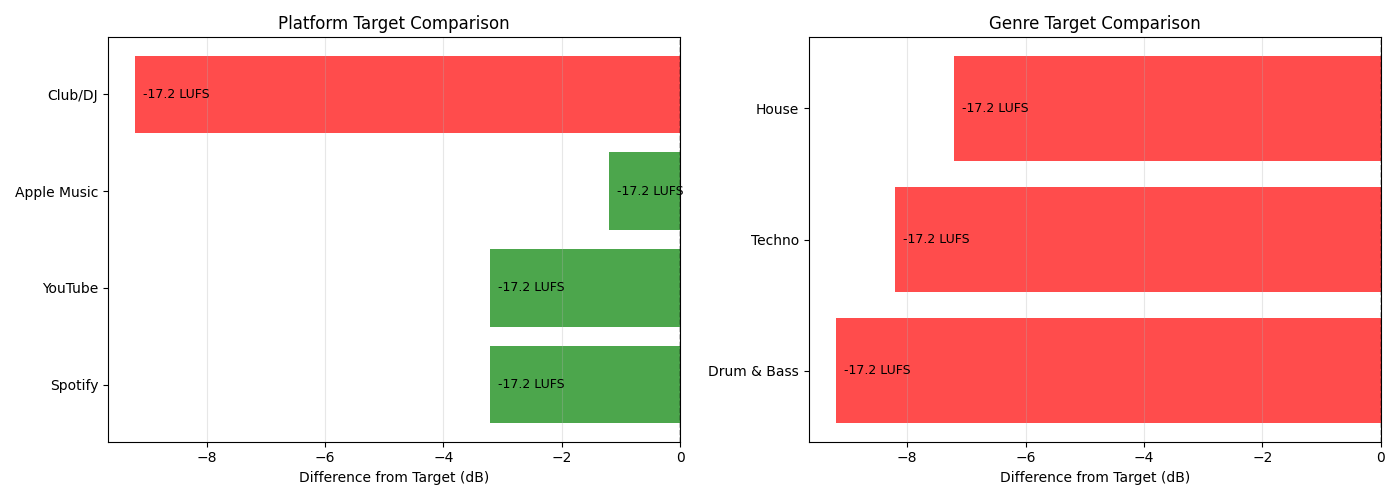
🎯 Platform Target Comparison:

✅ Spotify:
   3.2 dB below Spotify target (-14.0 LUFS). Still acceptable.

✅ YouTube:
   3.2 dB below YouTube target (-14.0 LUFS). Still acceptable.

✅ Apple Music:
   1.2 dB below Apple Music target (-16.0 LUFS). Still acceptable.

⚠️ Club/DJ:
   ⚠️ 9.2 dB below Club/DJ target (-8.0 LUFS). Consider increasing loudness.
Compare to Genre Targets
Check against genre-specific mastering practices.
genres_to_check = [Genre.DNB, Genre.TECHNO, Genre.HOUSE]

print("🎸 Genre Target Comparison:\n")
genre_results = []

for genre in genres_to_check:
    target = get_target(genre=genre)
    is_ok, diff, message = compare_to_target(result.integrated_lufs, target)

    genre_results.append({
        "genre": target.name,
        "target": target.target_lufs,
        "diff": diff,
        "ok": is_ok,
    })

    status = "✅" if is_ok else "⚠️"
    print(f"{status} {target.name}:")
    print(f"   {message}\n")
🎸 Genre Target Comparison:

⚠️ Drum & Bass:
   ⚠️ 9.2 dB below Drum & Bass target (-8.0 LUFS). Consider increasing loudness.

⚠️ Techno:
   ⚠️ 8.2 dB below Techno target (-9.0 LUFS). Consider increasing loudness.

⚠️ House:
   ⚠️ 7.2 dB below House target (-10.0 LUFS). Consider increasing loudness.
Visualize Target Comparison
Create a visual comparison of measured loudness vs targets.
fig, (ax1, ax2) = plt.subplots(1, 2, figsize=(14, 5))

# Platform targets
platform_names = [r["platform"] for r in platform_results]
platform_targets = [r["target"] for r in platform_results]
platform_diffs = [r["diff"] for r in platform_results]
platform_colors = ["green" if r["ok"] else "red" for r in platform_results]

ax1.barh(platform_names, platform_diffs, color=platform_colors, alpha=0.7)
ax1.axvline(x=0, color="black", linestyle="--", linewidth=1)
ax1.set_xlabel("Difference from Target (dB)")
ax1.set_title("Platform Target Comparison")
ax1.grid(axis="x", alpha=0.3)

# Add measured LUFS annotation
for i, (name, target, diff) in enumerate(zip(platform_names, platform_targets, platform_diffs)):
    measured = target + diff
    ax1.text(diff, i, f"  {measured:.1f} LUFS", va="center", fontsize=9)

# Genre targets
genre_names = [r["genre"] for r in genre_results]
genre_targets = [r["target"] for r in genre_results]
genre_diffs = [r["diff"] for r in genre_results]
genre_colors = ["green" if r["ok"] else "red" for r in genre_results]

ax2.barh(genre_names, genre_diffs, color=genre_colors, alpha=0.7)
ax2.axvline(x=0, color="black", linestyle="--", linewidth=1)
ax2.set_xlabel("Difference from Target (dB)")
ax2.set_title("Genre Target Comparison")
ax2.grid(axis="x", alpha=0.3)

for i, (name, target, diff) in enumerate(zip(genre_names, genre_targets, genre_diffs)):
    measured = target + diff
    ax2.text(diff, i, f"  {measured:.1f} LUFS", va="center", fontsize=9)

plt.tight_layout()
plt.show()
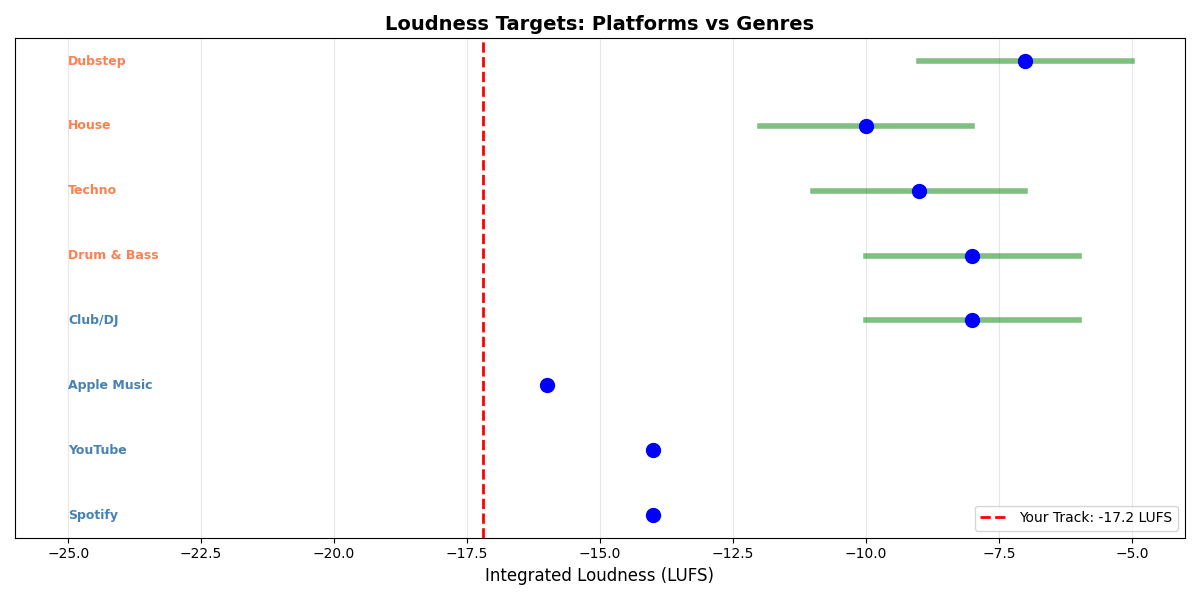
Target Ranges Visualization
Show acceptable loudness ranges for different platforms and genres.
fig, ax = plt.subplots(figsize=(12, 6))

# Collect all targets
all_targets = []
for platform in [Platform.SPOTIFY, Platform.YOUTUBE, Platform.APPLE_MUSIC, Platform.CLUB]:
    target = get_target(platform=platform)
    all_targets.append(("Platform", target))

for genre in [Genre.DNB, Genre.TECHNO, Genre.HOUSE, Genre.DUBSTEP]:
    target = get_target(genre=genre)
    all_targets.append(("Genre", target))

# Plot ranges
y_pos = np.arange(len(all_targets))
for i, (category, target) in enumerate(all_targets):
    # Target point
    ax.plot(target.target_lufs, i, "o", color="blue", markersize=10, zorder=3)

    # Acceptable range (if defined)
    if target.min_lufs is not None and target.max_lufs is not None:
        ax.plot([target.min_lufs, target.max_lufs], [i, i], "-",
                color="green", linewidth=4, alpha=0.5, zorder=2)

    # Color code by category
    color = "steelblue" if category == "Platform" else "coral"
    ax.text(-25, i, target.name, va="center", fontsize=9, color=color, weight="bold")

# Add measured loudness
ax.axvline(result.integrated_lufs, color="red", linestyle="--",
           linewidth=2, label=f"Your Track: {result.integrated_lufs:.1f} LUFS")

ax.set_yticks([])
ax.set_xlabel("Integrated Loudness (LUFS)", fontsize=12)
ax.set_title("Loudness Targets: Platforms vs Genres", fontsize=14, weight="bold")
ax.grid(axis="x", alpha=0.3)
ax.legend(loc="lower right")
ax.set_xlim(-26, -4)

plt.tight_layout()
plt.show()
Mastering Workflow Example
Demonstrate a typical mastering workflow with target checking.
def check_master(audio_file, target_platform=None, target_genre=None):
    """Check if a master meets target requirements.

    Args:
        audio_file: Path to audio file
        target_platform: Target platform (e.g., Platform.SPOTIFY)
        target_genre: Target genre (e.g., Genre.DNB)

    Returns:
        Dictionary with results and recommendations
    """
    # Load and analyze
    audio, sr = load_audio(audio_file)  # Uses native sample rate
    # load_audio returns (samples, 2) for stereo, transpose to (2, samples)
    if audio.ndim == 2:
        audio = audio.T
    result = calculate_lufs(audio, sr)

    # Get target
    if target_platform:
        target = get_target(platform=target_platform)
    elif target_genre:
        target = get_target(genre=target_genre)
    else:
        raise ValueError("Must specify target_platform or target_genre")

    # Compare
    is_ok, diff, message = compare_to_target(result.integrated_lufs, target)

    # Check true peak
    peak_ok = result.true_peak_db <= target.max_true_peak_db

    # Generate recommendations
    recommendations = []
    if not is_ok:
        if diff > 0:
            recommendations.append(f"Reduce gain by {abs(diff):.1f} dB")
        else:
            recommendations.append(f"Increase gain by {abs(diff):.1f} dB")

    if not peak_ok:
        peak_diff = result.true_peak_db - target.max_true_peak_db
        recommendations.append(f"True peak too hot by {peak_diff:.1f} dB - use limiting")

    if not recommendations:
        recommendations.append("Perfect! Ready for release.")

    return {
        "integrated_lufs": result.integrated_lufs,
        "true_peak_db": result.true_peak_db,
        "target_name": target.name,
        "target_lufs": target.target_lufs,
        "difference_db": diff,
        "lufs_ok": is_ok,
        "peak_ok": peak_ok,
        "ready_for_release": is_ok and peak_ok,
        "recommendations": recommendations,
    }


# Test the workflow
print("🎛️ Mastering Workflow Check:\n")

# Check for Spotify
spotify_check = check_master(test_file, target_platform=Platform.SPOTIFY)
print(f"Target: {spotify_check['target_name']}")
print(f"Measured: {spotify_check['integrated_lufs']:.1f} LUFS "
      f"(target: {spotify_check['target_lufs']:.1f} LUFS)")
print(f"Difference: {spotify_check['difference_db']:+.1f} dB")
print(f"Status: {'✅ Ready' if spotify_check['ready_for_release'] else '⚠️ Needs adjustment'}")
print(f"Recommendations:")
for rec in spotify_check['recommendations']:
    print(f"  - {rec}")
🎛️ Mastering Workflow Check:

Target: Spotify
Measured: -17.2 LUFS (target: -14.0 LUFS)
Difference: -3.2 dB
Status: ✅ Ready
Recommendations:
  - Perfect! Ready for release.
Clean up
test_file.unlink(missing_ok=True)

print("\n✨ LUFS metering and target comparison complete!")
✨ LUFS metering and target comparison complete!
Total running time of the script: (0 minutes 0.254 seconds)